
Mobile App Development Insights
Flutter for commerce: when a mobile app is worth building
A mobile app is not a growth channel by itself. How to decide whether your store has the repeat behavior, retention plan and support capacity to justify one.
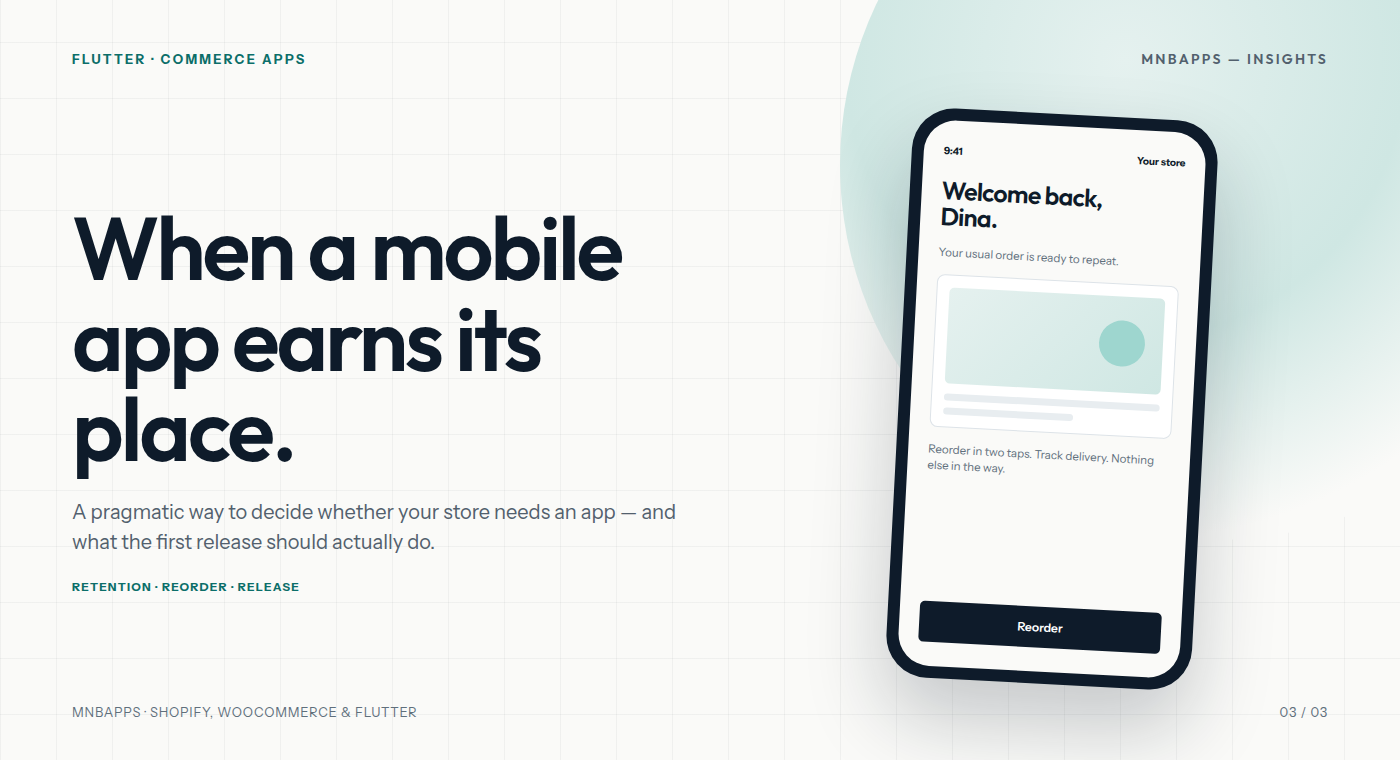
Most mobile app projects start with a screen list. A better starting point is a behavior: what do customers already do repeatedly, and would they do it more often if the friction were lower?
A commerce app is not a growth channel on its own. It is a retention product. If the store does not already have repeat purchase, account activity or a reason for customers to come back, an app usually gives those customers another place to ignore.
This is the framework we use to decide whether a Flutter app is worth building — and what the first release should contain if it is.
An app amplifies an existing habit
People install apps for repeated, valuable tasks: reordering consumables, tracking a subscription, checking a loyalty balance, managing a booking, or buying from a catalog they use weekly. They do not install an app because a store wants one more channel.
Before discussing features, look at the evidence in the existing store:
- Do customers already buy again without being prompted?
- Is a meaningful share of revenue from known, logged-in customers?
- Do customers contact support to do something the app could make self-service?
- Is there a real reason to notify them — a refill, a delivery update, a new drop, a membership benefit?
- Would faster access change behavior, or only move the same orders to a different screen?
If the answers are thin, fix retention on the web first. An app will not manufacture demand that the store has not earned.
Five signals an app is worth scoping
1. Repeat purchase is already part of the model
Coffee, supplements, pet supplies, consumables, refills and replacement parts have a natural reorder rhythm. The app earns its place by making that rhythm effortless: saved items, one-tap reorder, delivery tracking and a reminder at the right moment.
2. The valuable experience requires an account
Subscriptions, loyalty balances, saved builds, wholesale catalogs and order history are naturally app-shaped. If customers already log in to manage something, an app can reduce the friction of doing it on a phone.
3. Notifications have a job to do
“Download our app” is not a notification strategy. A useful notification is tied to a real event: your order has shipped, your refill is due, your back-in-stock item is available, your appointment is tomorrow. If you cannot describe the notification in one sentence, the app does not need push access.
4. Mobile web is the bottleneck
Some flows are genuinely better with native capabilities: camera-based product customization, barcode scanning, offline catalogs for field sales, or heavy account management. Build an app when the mobile web experience is structurally wrong for the job — not when it is merely imperfect.
5. The team can operate an app
An app is a product with its own release cycle. Someone has to own store listings, privacy disclosures, OS updates, crash monitoring, support and versioning. If no one owns that work after launch, the app becomes a stale icon.
When to stay on mobile web
Do not build an app when:
- Purchases are mostly one-off and discovery-led.
- The catalog is broad and changes constantly, with little repeat behavior.
- There is no retention plan beyond a generic newsletter.
- The team cannot support two release channels alongside the store.
- The app would only duplicate the website without making a specific task faster.
A responsive store, a fast checkout and a useful post-purchase email can outperform a neglected app. “We should have an app” is not a business case.
What belongs in a first release
The first version should do one job clearly. For most commerce apps, that means:
- Browse and search a focused catalog, with the same product data as the store.
- Account access with a low-friction sign-in and guest-friendly browsing.
- Reorder or saved items, if repeat purchase is the reason the app exists.
- Order tracking with clear status and a link to support.
- Notifications for events the customer opted into.
- Checkout through a flow you can actually support — often the existing Shopify checkout in a secure web view rather than a rebuilt payment stack.
Leave loyalty gamification, social feeds, in-app chat and a full content magazine for later. They add surface area before the core habit has been proven.
Flutter, native or a web wrapper?
Flutter is a good fit when you need one codebase for iOS and Android, a custom interface, and tight integration with an existing commerce backend. It gives you consistent behavior across platforms and a manageable release process for a small team.
Native development makes sense when the product depends on platform-specific capabilities — heavy camera work, AR, background location, wearables or performance-critical media. A web wrapper can be acceptable for a very small, content-led app, but it rarely feels native enough to earn repeat use.
The technology choice should follow the job. “Cross-platform” is not a benefit if the experience feels compromised on both platforms.
Integration is the real scope
The screen designs are the easy part. The project gets real when you connect identity, catalog, cart, orders and support.
- Catalog: Shopify Storefront API or the WooCommerce REST API, with caching and sensible pagination.
- Accounts: a clear decision between platform customer accounts and a separate identity layer. Avoid two sources of truth.
- Cart and checkout: keep tax, shipping, discounts and payment logic in the commerce platform wherever possible.
- Orders: order history, tracking and returns should read from the same system the store uses.
- Lifecycle: deep links, push permissions, analytics events and account deletion need to be designed, not bolted on.
Do not rebuild checkout unless checkout is the product. Every custom payment path adds security, compliance and maintenance work that outlives the launch.
Plan for the second year, not just the launch
App store review, OS releases and dependency updates do not stop. A useful rule is to budget for the app as an ongoing product from day one: monitoring, support, store listings, release cadence and a named owner.
Measure the things that justify that cost:
- Activation: how many installs reach a first meaningful action?
- Repeat purchase: are app customers ordering more often than before?
- Retention: are they still using the app after 30 and 90 days?
- Reliability: crash-free sessions and failed checkout attempts.
- Support load: are app users contacting support less, or more?
Downloads are a vanity metric. A smaller group of customers who reorder every month is a better outcome than a large install base that opens the app once.
The decision
Build the app when repeat behavior already exists, the mobile experience unlocks something the web cannot, and the team can support the product after launch. Otherwise, improve the mobile store and come back when the retention data is stronger.
If you are weighing up a commerce app, our mobile app development service covers product scope, Flutter build, commerce integration and release. You can send us the short version and we will tell you whether an app is the right next move — including when it is not.


